. 2025 Jun 2;8(6):e2514452.
doi: 10.1001/jamanetworkopen.2025.14452.

Multinational Attitudes Toward AI in Health Care and Diagnostics Among Hospital Patients

Felix Busch  1 , Lena Hoffmann  2 , Lina Xu  2 , Long Jiang Zhang  3 , Bin Hu  3 , Ignacio García-Juárez  4   5 , Liz N Toapanta-Yanchapaxi  6 , Natalia Gorelik  7 , Valérie Gorelik  8 , Gaston A Rodriguez-Granillo  9 , Carlos Ferrarotti  10 , Nguyen N Cuong  11 , Chau A P Thi  12 , Murat Tuncel  13 , Gürsan Kaya  13 , Sergio M Solis-Barquero  14 , Maria C Mendez Avila  14 , Nevena G Ivanova  15   16   17 , Felipe C Kitamura  18   19 , Karina Y I Hayama  18 , Monserrat L Puntunet Bates  20 , Pedro Iturralde Torres  21 , Esteban Ortiz-Prado  22 , Juan S Izquierdo-Condoy  22 , Gilbert M Schwarz  23 , Jochen G Hofstaetter  24   25 , Michihiro Hide  26 , Konagi Takeda  27 , Barbara Peric  28   29 , Gašper Pilko  28   29 , Hans O Thulesius  30   31 , Thomas Lindow  32   33 , Israel K Kolawole  34 , Samuel Adegboyega Olatoke  35 , Andrzej Grzybowski  36 , Alexandru Corlateanu  37 , Oana-Simina Iaconi  38 , Ting Li  39 , Izabela Domitrz  40   41 , Katarzyna Kepczynska  40   41 , Matúš Mihalcin  42   43 , Lenka Fašaneková  42   43 , Tomasz Zatonski  44 , Katarzyna Fulek  44 , András Molnár  45 , Stefani Maihoub  45 , Zenewton A da Silva Gama  46 , Luca Saba  47 , Petros Sountoulides  48 , Marcus R Makowski  1 , Hugo J W L Aerts  49   50   51   52 , Lisa C Adams  1 , Keno K Bressem  1   53 ; COMFORT consortium; Álvaro Aceña Navarro  54   55 , Catarina Águas  56 , Martina Aineseder  57 , Muaed Alomar  58 , Rashid Al Sliman  59 , Gautam Anand  60 , Salita Angkurawaranon  61 , Shuhei Aoki  62 , Samuel Arkoh  63 , Gizem Ashraf  64 , Yesi Astri  65 , Sameer Bakhshi  66 , Nuru Y Bayramov  67 , Antonis Billis  68 , Almir G V Bitencourt  69 , Anetta Bolejko  70   71 , Antonio J Bollas Becerra  54 , Joe Bwambale  72 , Andreia Capela  73   74 , Riccardo Cau  47 , Kelly R Chacon-Acevedo  75 , Tafadzwa L Chaunzwa  50   52 , Rubens Chojniak  69 , Warren Clements  76   77   78 , Renato Cuocolo  79 , Victor Dahlblom  70 , Kelienny de Meneses Sousa  46 , Jorge Esteban Villarrubia  80 , Vijay B Desai  81 , Ajaya K Dhakal  82 , Virginia Dignum  83 , Rubens G Feijo Andrade  84 , Giovanna Ferraioli  85 , Shuvadeep Ganguly  66 , Harshit Garg  86 , Cvetanka Gjerakaroska Savevska  87 , Marija Gjerakaroska Radovikj  88 , Anastasia Gkartzoni  68 , Luis Gorospe  89 , Ian Griffin  90 , Martin Hadamitzky  91 , Martin Hakorimana Ndahiro  92 , Alessa Hering  93   94 , Bruno Hochhegger  90 , Mehriban R Huseynova  67 , Fujimaro Ishida  95 , Nisha Jha  96 , Lili Jiang  83 , Rawen Kader  97 , Helen Kavnoudias  76   77   78   98 , Clément Klein  99 , George Kolostoumpis  100 , Abraham Koshy  101 , Nicholas A Kruger  102 , Alexander Löser  103 , Marko Lucijanic  104   105 , Despoina Mantziari  68 , Gaelle Margue  99 , Sonyia McFadden  106 , Masahiro Miyake  107 , Wipawee Morakote  61 , Issa Ngabonziza  92 , Thao T Nguyen  108 , Stefan M Niehues  2 , Marc Nortje  102 , Subish Palaian  58 , Natalia V Pentara  109 , Rui P Pereira de Almeida  110   111 , Gianluigi Poma  112 , Mitayani Purwoko  113 , Nikolaos Pyrgidis  114 , Vasileios Rafailidis  109 , Clare Rainey  106 , João C Ribeiro  115 , Nicolás Rozo Agudelo  75 , Keina Sado  107 , Julia M Saidman  116 , Pedro J Saturno-Hernandez  117 , Vidyani Suryadevara  118 , Gerald B Schulz  114 , Ena Soric  104 , Javier Soto-Pérez-Olivares  89 , Arnaldo Stanzione  119 , Julian Peter Struck  59 , Hiroyuki Takaoka  120 , Satoru Tanioka  121   122 , Tran T M Huyen  108 , Daniel Truhn  123 , Elon H C van Dijk  124   125 , Peter van Wijngaarden  64   126 , Yuan-Cheng Wang  127 , Matthias Weidlich  2 , Shuhang Zhang  127
Affiliations

Multinational Attitudes Toward AI in Health Care and Diagnostics Among Hospital Patients

Felix Busch et al. JAMA Netw Open. .

Abstract

Importance: The successful implementation of artificial intelligence (AI) in health care depends on its acceptance by key stakeholders, particularly patients, who are the primary beneficiaries of AI-driven outcomes.

Objectives: To survey hospital patients to investigate their trust, concerns, and preferences toward the use of AI in health care and diagnostics and to assess the sociodemographic factors associated with patient attitudes.

Design, setting, and participants: This cross-sectional study developed and implemented an anonymous quantitative survey between February 1 and November 1, 2023, using a nonprobability sample at 74 hospitals in 43 countries. Participants included hospital patients 18 years of age or older who agreed with voluntary participation in the survey presented in 1 of 26 languages.

Exposure: Information sheets and paper surveys handed out by hospital staff and posted in conspicuous hospital locations.

Main outcomes and measures: The primary outcome was participant responses to a 26-item instrument containing a general data section (8 items) and 3 dimensions (trust in AI, AI and diagnosis, preferences and concerns toward AI) with 6 items each. Subgroup analyses used cumulative link mixed and binary mixed-effects models.

Results: In total, 13 806 patients participated, including 8951 (64.8%) in the Global North and 4855 (35.2%) in the Global South. Their median (IQR) age was 48 (34-62) years, and 6973 (50.5%) were male. The survey results indicated a predominantly favorable general view of AI in health care, with 57.6% of respondents (7775 of 13 502) expressing a positive attitude. However, attitudes exhibited notable variation based on demographic characteristics, health status, and technological literacy. Female respondents (3511 of 6318 [55.6%]) exhibited fewer positive attitudes toward AI use in medicine than male respondents (4057 of 6864 [59.1%]), and participants with poorer health status exhibited fewer positive attitudes toward AI use in medicine (eg, 58 of 199 [29.2%] with rather negative views) than patients with very good health (eg, 134 of 2538 [5.3%] with rather negative views). Conversely, higher levels of AI knowledge and frequent use of technology devices were associated with more positive attitudes. Notably, fewer than half of the participants expressed positive attitudes regarding all items pertaining to trust in AI. The lowest level of trust was observed for the accuracy of AI in providing information regarding treatment responses (5637 of 13 480 respondents [41.8%] trusted AI). Patients preferred explainable AI (8816 of 12 563 [70.2%]) and physician-led decision-making (9222 of 12 652 [72.9%]), even if it meant slightly compromised accuracy.

Conclusions and relevance: In this cross-sectional study of patient attitudes toward AI use in health care across 6 continents, findings indicated that tailored AI implementation strategies should take patient demographics, health status, and preferences for explainable AI and physician oversight into account.


Conflict of interest statement

Conflict of Interest Disclosures: Dr Rodriguez-Granillo reported being a consultant for Caristo Diagnostics outside the submitted work. Dr Kitamura reported receiving personal fees from Bunkerhill Health, MD.ai, Sharing Progress in Cancer Care, and GE Healthcare outside the submitted work; being an early career consultant to the editor of Radiology, an associate editor of Radiology: Artificial Intelligence, vice-chair of the Society for Imaging Informatics in Medicine machine learning committee, member of the Radiological Society of North America (RSNA) AI committee, and member of the RSNA Radiology Informatics Council. Dr Bressem reported receiving grants from Bayern Innovativ, the funding agency of the State of Bavaria, Germany; German Federal Ministry of Education and Research; and the Wilhelm-Sander Foundation; receiving a scholarship from the Max Kade Foundation; and receiving personal fees from Canon Medical Systems Corporation and GE HealthCare; all outside the submitted work. Dr Bwambale reported receiving personal fees as compensation for expenses incurred during the study outside the submitted work. Dr Esteban-Villarrubia reported receiving grants from Astellas and receiving personal fees from BMS, Ipsen, MSD, and Janssen outside the submitted work. Dr Ferraioli reported receiving personal fees from Canon Medical Systems, Philips Healthcare, Mindray Bio-Medical Electronics, Siemens Healthineers, Esaote SpA, and Elsevier outside the submitted work. Dr Kader reported receiving personal fees from Odin Vision Ltd outside the submitted work. Dr Miyake reported receiving grants from Novartis Pharma, Rhoto Pharma, Kaneka, and Daiichi Sankyo Pharma; and receiving personal fees from Santen Pharma, FINDEX Inc, Chugai Pharma, JINS, and Senju Pharma outside the submitted work. Dr Niehues reported receiving personal fees from Canon Medical, Bracco Imaging, and Teleflex during the conduct of the study. Dr Sado reported receiving personal fees from Fitting Cloud Inc outside the submitted work. Dr Truhn reported being a shareholder of StratifAI GmbH and Synagen GmbH.

Figures

Figure 1.
Figure 1.. Geographical Distribution of Participating Institutions on World Map
The size of the blue dots refers to the proportion of respondents per institution relative to the total number of respondents. Countries with at least 1 participating institution are highlighted in green.
Figure 2.
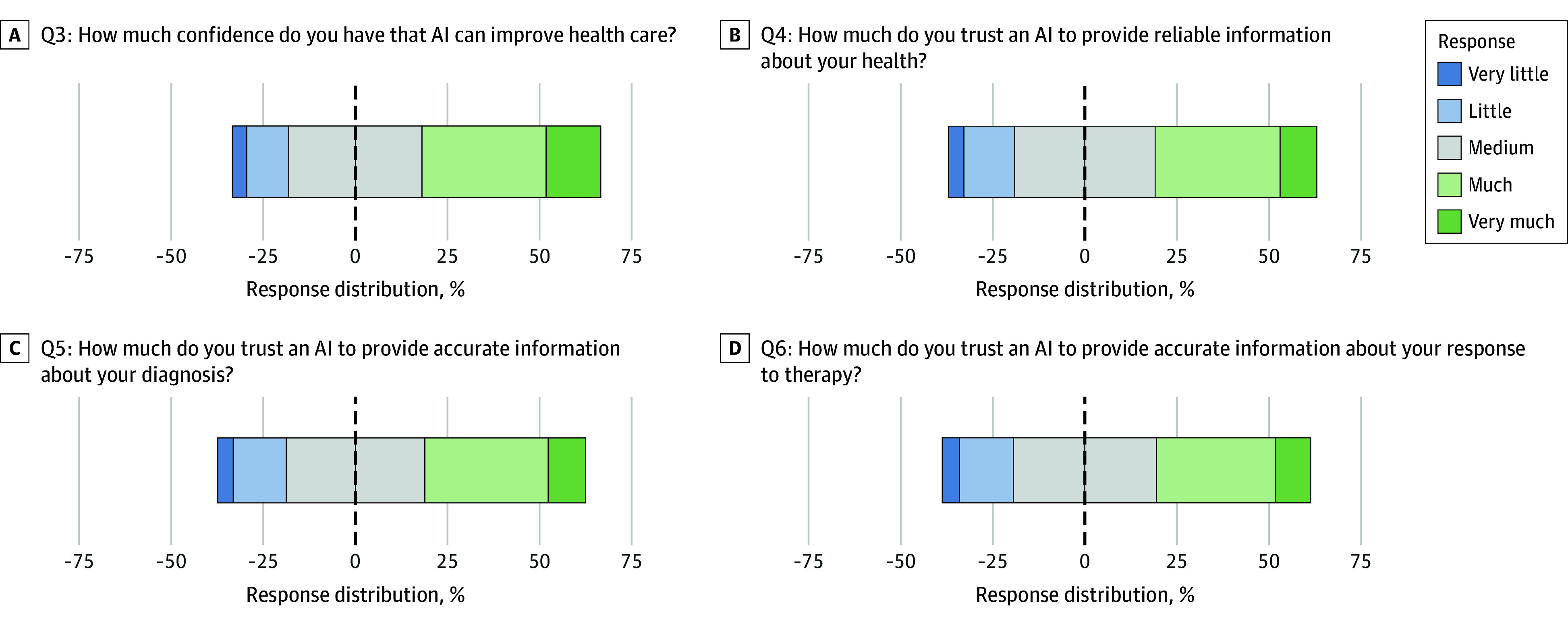
Figure 2.. Gantt Diagrams Depicting the Results for Each Item in the Trust in Artificial Intelligence (AI) Section
Q3 through Q6 represent question items 3 through 6.
Figure 3.
Figure 3.. Gantt Diagrams Depicting the Results for Each Item in the Concerns Toward AI Section
Q17 through Q20 represent question items 17 through 20. AI indicates artificial intelligence.

References

    1. Peres RS, Jia X, Lee J, Sun K, Colombo AW, Barata J. Industrial artificial intelligence in industry 4.0 - systematic review, challenges and outlook. IEEE Access. 2020;8:220121-220139. doi: 10.1109/ACCESS.2020.3042874 - DOI
    1. Choudhury A, Shamszare H. Investigating the impact of user trust on the adoption and use of ChatGPT: survey analysis. J Med Internet Res. 2023;25:e47184. doi: 10.2196/47184 - DOI - PMC - PubMed
    1. Davenport T, Kalakota R. The potential for artificial intelligence in healthcare. Future Healthc J. 2019;6(2):94-98. doi: 10.7861/futurehosp.6-2-94 - DOI - PMC - PubMed
    1. Jiang F, Jiang Y, Zhi H, et al. Artificial intelligence in healthcare: past, present and future. Stroke Vasc Neurol. 2017;2(4):230-243. doi: 10.1136/svn-2017-000101 - DOI - PMC - PubMed
    1. Ferrari R, Mancini-Terracciano C, Voena C, et al. MR-based artificial intelligence model to assess response to therapy in locally advanced rectal cancer. Eur J Radiol. 2019;118:1-9. doi: 10.1016/j.ejrad.2019.06.013 - DOI - PubMed

Publication types